The Tunnel that Wasn't Supposed to Exist (And Why it Matters)
By
Suz Pathmanathan

Most passengers riding through the Thames Tunnel on the London Overground have no idea they're passing through a whorl in time. A tunnel that wasn't supposed to exist, built 180 years ago.
Because in 1808, the best engineers in Britain looked at the problem of crossing beneath the Thames and reached a formal conclusion: an underground tunnel is an impracticable feat of engineering.
They weren't saying this because they'd rather huddle around watching Bake Off, or whatever the equivalent was at the time, perhaps chasing a chicken around or playing catch with a hot potato. They'd actually tried. And like so many stories of innovation from that era, this one is a story of patience; of planting a seed of ambition in the hope it'll take root.
A team of Cornish miners, men who had carved passages through granite their whole lives, spent four years digging toward Wapping. When they hit the soft clay and quicksand beneath the Thames, they had no answer for it. The tunnel flooded. Twice.

Marc Brunel, a French-born engineer working with his twenty-year-old son Isambard, invented an entirely new way of moving through unstable ground: a tunnelling shield that would hold the earth back as workers excavated inch by inch inside it. It took eighteen years to go from patent to first shovel. It took another eighteen years to finish the tunnel itself.
It flooded six times. Six men drowned. Isambard nearly died when he was pulled unconscious from a locked emergency exit as the Thames broke through overhead. The project ran out of money and sat idle for seven years until the Treasury stepped in with what would be millions in today's money.
By the time it finally opened on 25 March 1843, Marc Brunel was 73 years old, had suffered a stroke, and was too ill to oversee the final stages. The tunnel he had conceived two decades earlier opened not as the goods crossing it was always meant to be, but as a pedestrian walkway. He had spent his health, his fortune, and eighteen years of his life on something the world would call the eighth wonder and which would earn its keep by charging visitors a penny a head. That particular mix of pride and loss doesn't have a clean name.
Within ten weeks, a million people had visited. Half of London's population.That tunnel is now older than the concept of a structural engineer as a profession. It's older than the theory of plate tectonics. It pre-dates the invention of concrete as we know it. And it is one of thousands of Victorian infrastructure structures still quietly doing their job beneath British cities every single day.
Across Britain, more than 30,000 bridges, tunnels and viaducts are over 150 years old. Thousands of structures in active use were built in the railway age, with methods and materials that no living engineer designed. We don't always know exactly what's in them. We don't always know exactly what they're doing.
What we do know is that they breathe with time, moving continuously, responding to temperature, to load, to everything passing through them and over them. And for most of their lives, we have checked in on them occasionally, with a surveyor and a total station, and then left them alone.
The question is no longer whether we should be paying closer attention. It's whether we finally have a way to do it.
The pilot we ran in the UK, run with Academy Geomatics, is the answer to that.
Academy Geomatics had been tasked with designing a monitoring scheme for a tunnel under threat from nearby construction. Excavation, pile driving, and dewatering all changed the stress state of the subsoil and the risk of deformation needed to be taken seriously.
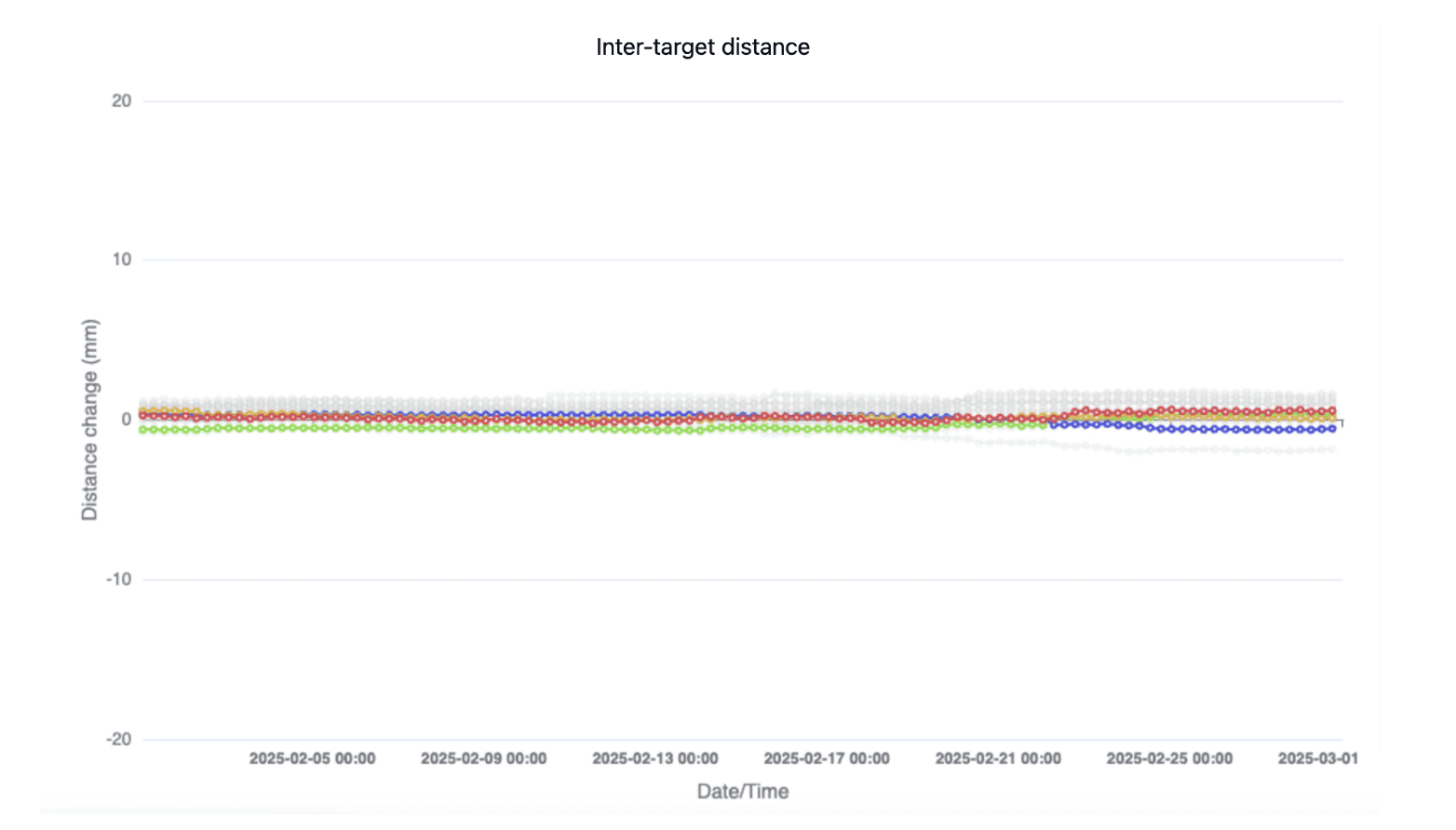
The proven approach was an automated total station: real-time x, y, z displacement data, prism targets fixed to the tunnel lining, continuous output. It works, but it has a problem. Total stations are bulky, and tunnel operators are, reasonably, protective of their clearance envelopes. They're also maintenance-hungry: regular site visits, every one of them logistically costly in a live operational environment.
Academy Geomatics brought in TotaLite alongside the existing total station, observing the same targets. Three tunnel sections, five prisms each. The installation took place during a planned shutdown window, alongside other maintenance works and completed on schedule, thanks to the sensor's compact form factor and straightforward setup.
What followed was three months of continuous data collection, with no site visits required.
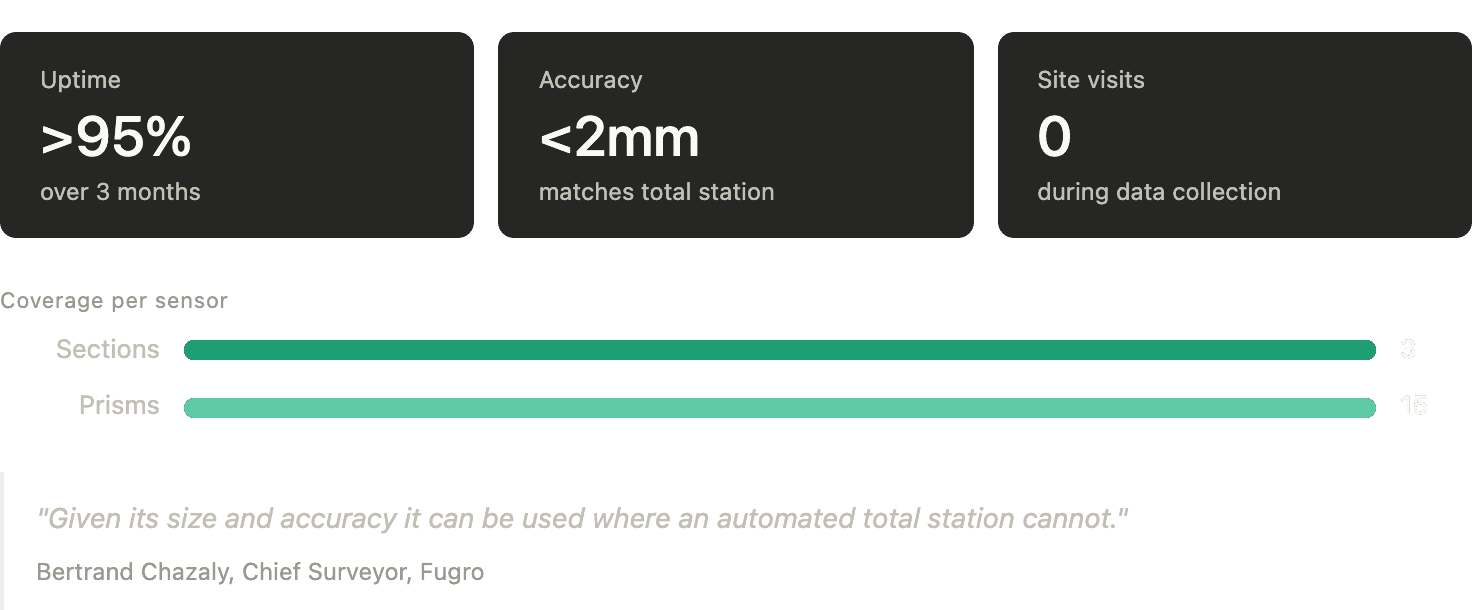
The results: greater than 95% uptime. Accuracy within 2mm, closely matching the total station throughout. When the pilot concluded, the findings fed directly into the development of the A2.0, improved accuracy, stronger robustness for harsh tunnel environments, and more seamless data transmission.
Bertrand Chazaly, Chief Surveyor at Fugro, put it plainly: TotaLite can be deployed where a total station simply cannot.
Marc Brunel built his tunnelling shield because existing tools had no answer for soft ground beneath a river. The shield didn't replace skill or expertise, it gave engineers a way to work in conditions that had previously stopped them cold.
The monitoring gap in ageing infrastructure is a similar problem. The tools we've relied on were built for a different era of access, cost, and data expectation. What's changed isn't the tunnels, it's what we're now able to ask of them.
Curious to know how TotaLite could work for your projects? Get in touch: https://www.totalite.io/book-a-demo.