Our honest thoughts on Intergeo 2026
By
Suz Pathmanathan

Intergeo brought together the surveying and geomatics world in Munich this September, and TotaLite was there to share where we've come from and where we're headed. Epco Berger opened our keynote with a number that puts the scale of the problem in perspective: TNO estimates the Netherlands alone needs €260 billion to renew its infrastructure through 2100, with more than €3 billion in annual replacement spend required by 2040. Infrastructure is aging faster than it can be replaced, demands on it are rising, and there is a shortage of experienced experts to inspect it all.
Too often, asset owners simply don't have enough insight into real asset conditions to plan and prioritise well.
The cost of that gap is not abstract. Even a "minor" closure, one with no collapse and no national headlines, can run into the tens of millions. The 2024 closure of the Prinses Margriettunnel cost an estimated €202 million once repairs, lost travel time, and the economic and environmental impact were counted. The Vollenhoven Tunnel closure that same year cost roughly €26 million, nearly eight times lower. The difference came down to early warning. Continuous monitoring picked up the failure mechanism as it began: foundation anchors tearing and breaking. That gave the asset owner time to take preventive action before the whole tunnel had to close. When warning signs go unseen, the outcome is far worse, as the world saw in 2018 when the Ponte Morandi collapsed in Genoa.
The case for continuous monitoring
TNO's modelling suggests preventive, condition-based maintenance could deliver 15 to 30 percent lower maintenance costs and 20 to 50 percent higher asset availability. Applied at scale, that's an estimated €100 billion in savings for the Dutch state alone.
The idea is not new. What has been missing is a practical way to do it. Traditional continuous monitoring stayed rare because it depended on expensive hardware, periodic rather than truly continuous surveys, and specialist surveyors to install, read and interpret the data. Even where the ROI case was clear, scaling it across thousands of assets was never realistic.
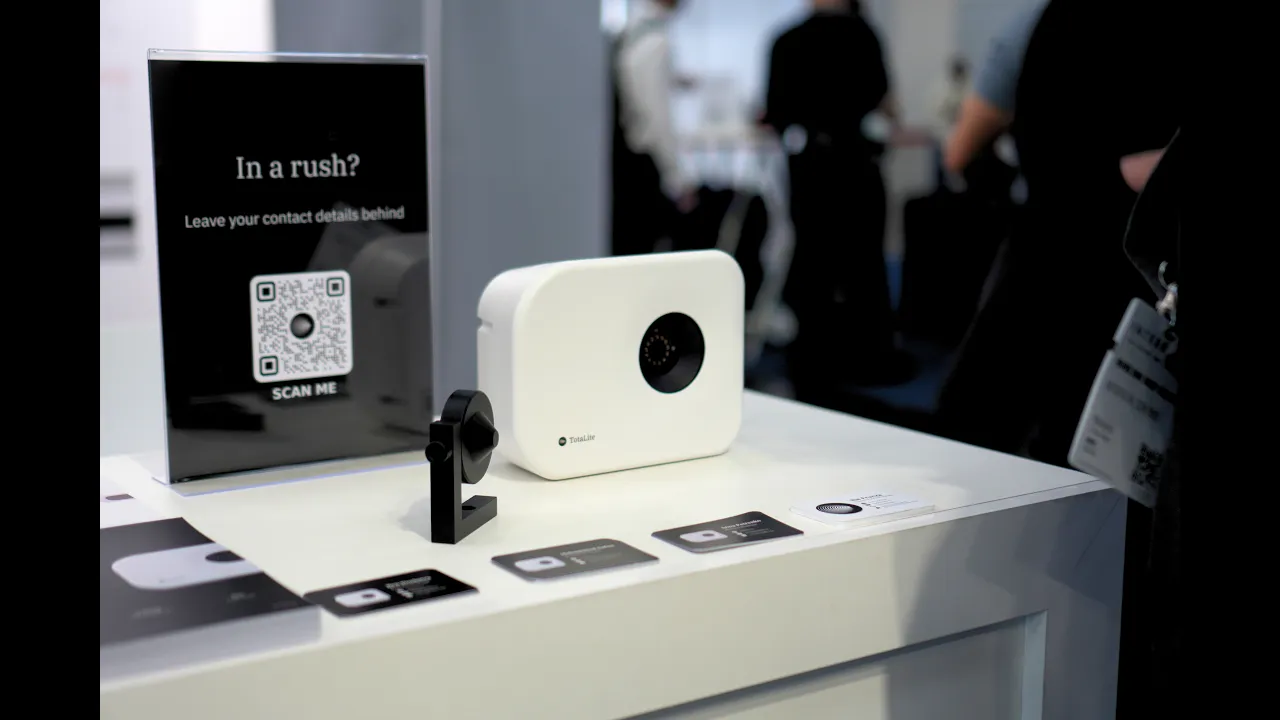
That is the gap TotaLite is built to close: a compact, camera-based optical sensor and cloud platform that delivers millimetre-level displacement monitoring continuously and automatically, without the cost or complexity of traditional surveying systems. It's designed to sit alongside the expertise of surveyors and engineers, not replace it, turning continuous real-world data into the kind of clear, timely insight that supports faster, better-informed decisions.
Conversations that stuck with us
Some of the best conversations at Intergeo didn't fit neatly into a pitch.
A rail engineer told us he's responsible for monitoring several hundred total stations across a Chinese rail network, and wanted to know whether TotaLite could support that work in tunnels specifically. Engineers from Japan asked detailed, practical questions about testing a single unit on a live project of their own, the kind of interest that goes beyond curiosity. In Romania, the driver is regulation: monitoring is now a legal requirement on construction sites, and that is pulling real attention toward continuous solutions.
And from Sweden came a story that stopped us in our tracks. An entire village is being relocated because it sits above an active mine, and the church has already been moved. Beneath it, more than 500 km of underground roads need to be monitored.
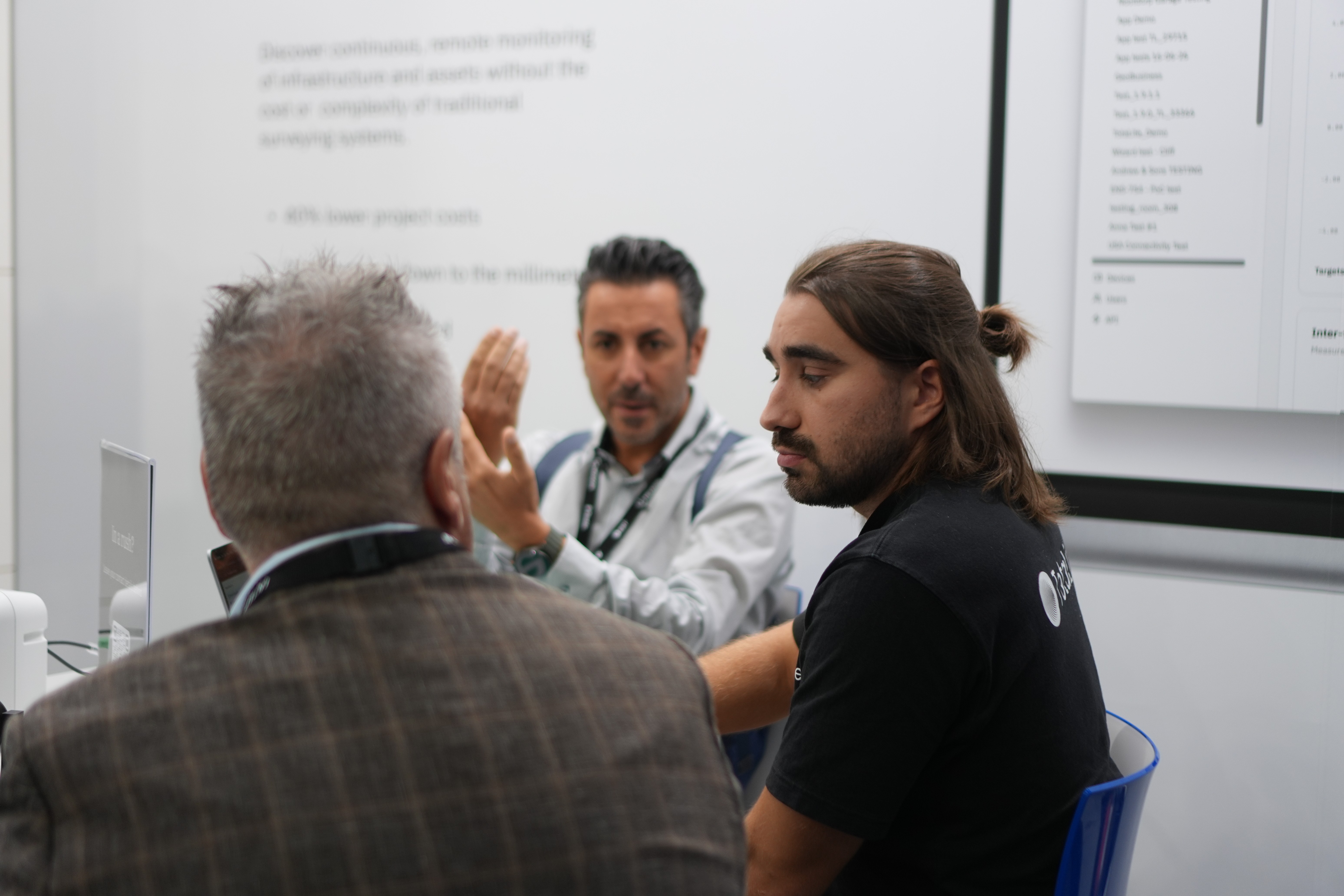
We came home with some incredible leads, many from across Europe. Some of the most encouraging conversations were with people who already know us. One monitoring contractor working on a major Alpine tunnel tested our first-generation sensor two years ago. It wasn't ready for them then. Having seen how far the product has come, they're now considering TotaLite for parts of that project. Another firm, which recently won a large tunnel contract based on total stations, is looking at doing part of the work with TotaLite.
We also got the same question more than once after Epco stepped off the main stage: does using TotaLite mean installing a network of sensors that all talk to each other across a site? It doesn't. TotaLite is a single sensor that tracks multiple targets from one fixed position. It works on the same principle as a total station, just automated and continuous.

One more thing came up in conversation after conversation, and it had nothing to do with monitoring technology: theft of survey equipment from site. It's a real, practical headache for many of the people we spoke to, and a reminder that anything left in the field has to survive more than the weather. Our sensor is compact and easy to cage. And if it's stolen, it's useless to the thief, because no data is stored on the device itself.
Proof from the field
Two case studies from our keynote show our success in real world applications. For Academy Geomatics, nearby construction risked destabilising an active UK metro tunnel. Traditional automated total stations were too bulky for the available clearance and needed costly recalibration visits. TotaLite ran continuously instead, with zero site visits required, more than 95 percent uptime over three months, and accuracy within 2mm, matching the total station it was benchmarked against.
For Terra Measurements, a 185-year-old Victorian masonry bridge spanning an active rail line in Staffordshire needed structural monitoring through refurbishment without disrupting rail operations. Manual total station surveys would have meant labour-intensive, costly visits with real safety risk for surveyors. TotaLite ran 24/7 instead, with zero disruption to rail traffic, a 65 percent cost saving from eliminating weekly site visits, and continuous data that exposed daily temperature-linked movement cycles that periodic surveys had never caught.
What we heard from you
Following Epco’s keynote, we had a swell of interest that solidified in our minds that the best part of Intergeo is always the conversations on the stand, and this year told us a few things clearly. A lot of you have been watching TotaLite for a while, some of you have tested an early version, and many of you noticed just how much we've shipped this past year.
Thank you for that, it means a lot to the whole team.
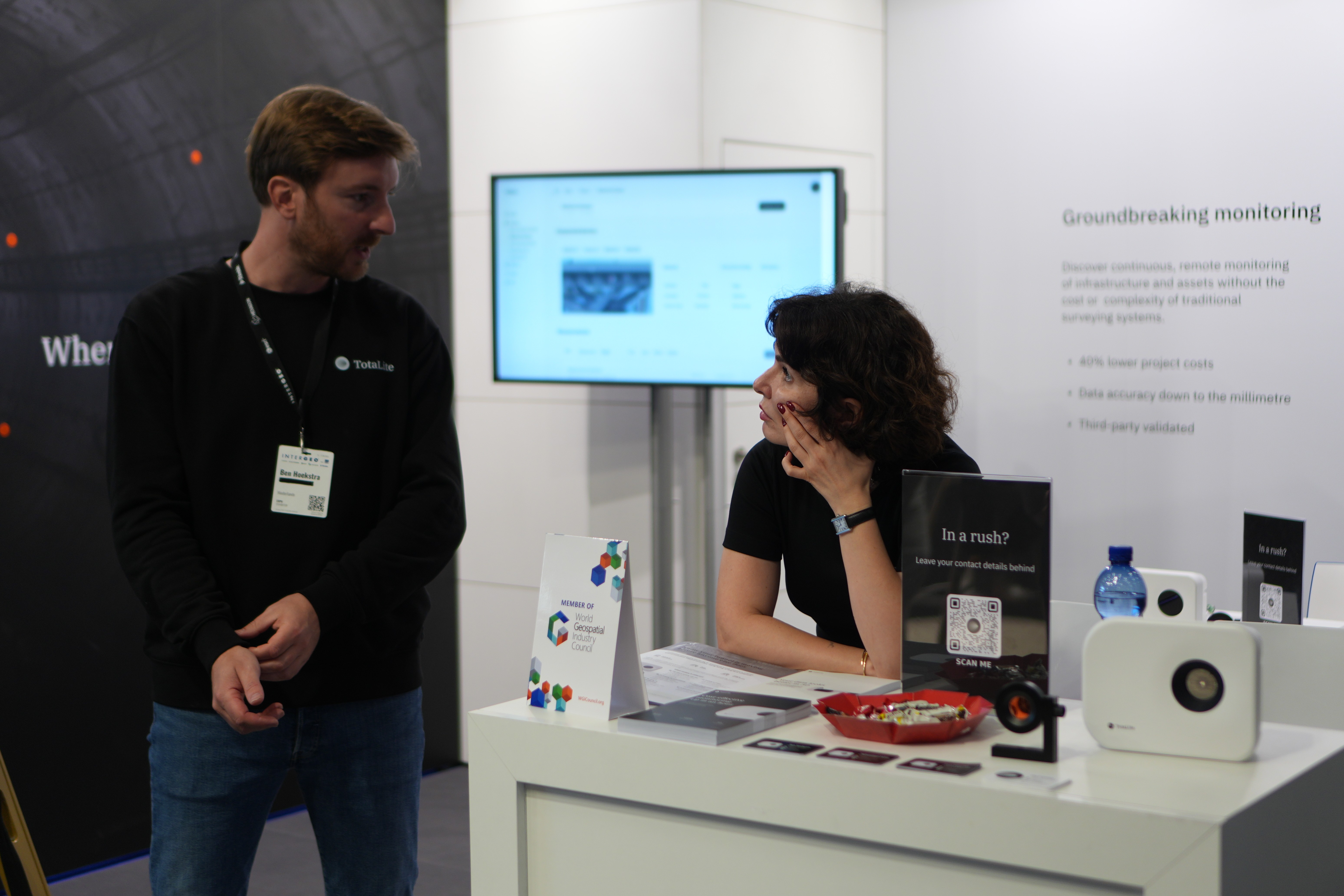
Interest this year was also global in a way that stood out to us, with conversations spanning Europe through to Japan and the wider Asia-Pacific region. Wherever people are managing ageing or heavily used infrastructure, the same underlying question comes up: how do you know an asset is moving before it becomes a serious problem?
And we heard the ask to see more of TotaLite in action, across more asset types and more real projects. Bridges, tunnels, retaining walls, quaysides, rail, and beyond. Consider that noted, and expect to see more of it from us going forward.
Thank you to everyone who stopped by our stand, asked a question, or just said hello. If you weren't able to make it to Munich and want to see TotaLite for yourself, get in touch.