SMALLER BRIDGES, CONTINUOUSLY PROTECTED
Continuous, millimeter-precision structural monitoring at a fraction of the cost of traditional methods.

70%
reduction of project man-hours
40–65%
project cost reduction by eliminating manual visits
25 targets
tracked from a single sensor, up to 70 m away
THE CHALLENGE
Across many countries, critical infrastructure, bridges, tunnels, railways, and roads, is ageing faster than budgets can keep pace with. Maintenance costs keep climbing, while limited funds are directed toward the largest structures. Smaller bridges are too often left without the attention they need, until a problem is discovered too late.
A 2025 Cerema assessment of 35,260 communal bridges in France found:
29% are in significantly poor condition and require inspection and repair in the short term.
7% require immediate action.
6% present severe safety concerns, requiring closure or a reduced weight limit.
The estimated annual maintenance cost for these bridges (and walls) alone ranges between €128 million and €241 million.
View the interactive bridge map →
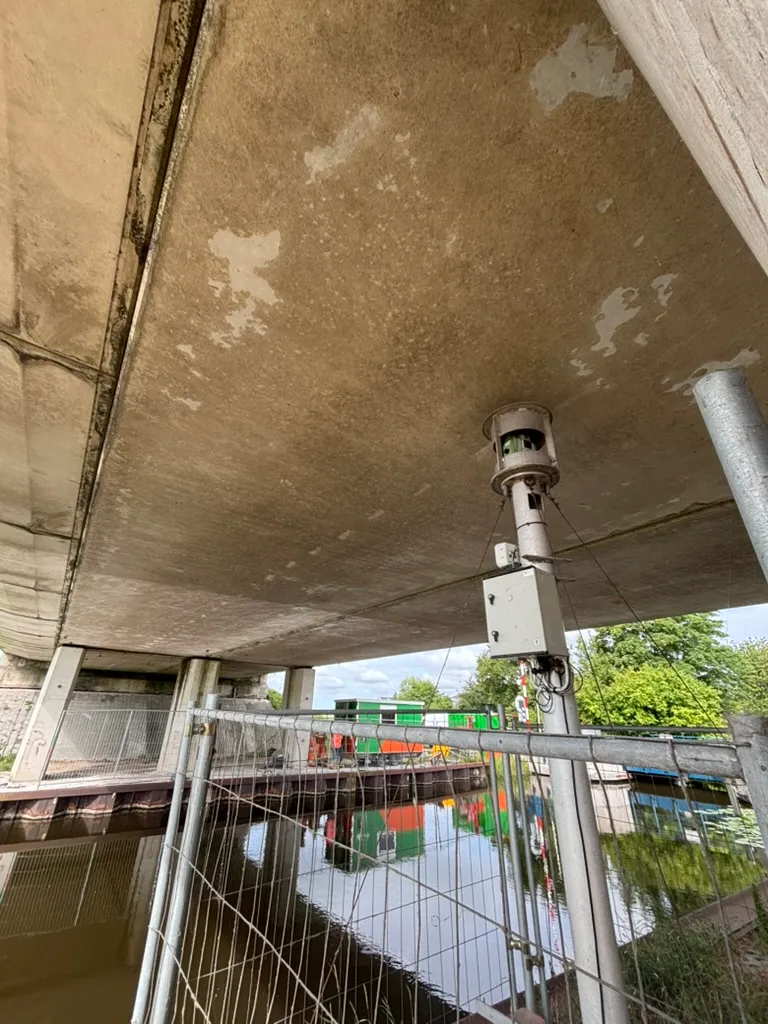
Left unmonitored, structural deformation can go undetected until it becomes dangerous, and expensive to fix. Continuous monitoring is the most effective way to catch problems early, but until now, the tools available have been too costly to deploy beyond the largest structures.
Why Traditional Monitoring Falls Short
For decades, Robotic Total Stations (RTS) have been the industry standard for structural monitoring, and they remain highly accurate instruments. But the way they are typically deployed creates real limits on how widely the technology can be scaled across critical infrastructure:
Robotic Total Station deployment
The high upfront and operating costs are generally only justified for the largest, highest-risk structures. Multiple site visits from experts are needed for setup and calibration.
Another solution is periodic manual monitoring. This generally reduces the costs of full-scale RTS deployment, but leads to other limits:
Periodic manual monitoring
Limited ability to track many points at once without additional equipment or repeat visits. Data is captured periodically rather than continuously, leaving large gaps between measurements.
As a result, thousands of smaller, structurally significant bridges remain unmonitored, not because they don’t matter, but because the economics of traditional monitoring don’t work at that scale.
THE TOTALITE SOLUTION
TotaLite has developed a compact optical sensor purpose-built to make continuous structural monitoring accessible at scale. For most small and mid-sized bridges, a single sensor is enough to monitor the entire structure remotely, with no routine site visits required.
Up to 25 targets
Tracked simultaneously from one sensor.
Up to 70 metres
Millimeter-level precision from a safe distance.
24 / 7 real-time data
Alerts the asset owner when movement exceeds expected limits.
No recalibration
Only pay the subscription during the monitoring period.
For most small and mid-sized bridges, this means a single sensor is enough to monitor the entire structure remotely, with no site visits required. The moment a structural deformation moves outside expected limits, TotaLite alerts the asset owner immediately, so problems can be addressed before they become dangerous.
HOW IT WORKS
The sensor is positioned facing the structure from up to 70 metres away and begins monitoring immediately. A step-by-step mobile app guides the installer through configuration in approximately 20 minutes, no specialist training required.
Field of view: 60° horizontal / 45° vertical
Coverage: up to 70 m of bridge length from one central sensor
Measurement frequency: one reading every 5 minutes
Capacity: max. 25 prisms tracked at once
What do you need for your project
Per bridge, the following is needed:
TotaLite sensor
Monthly subscription to the TotaLite platform
Up to 25 standard surveying prisms
0.7” or greater than 17 mm diameter. Although they might work, 360-degree prisms are not supported.
Mounting: TotaLite bracket
Off-grid options: battery and, optionally, solar panel

CUSTOMER PROOF

65%
cost reduction by eliminating weekly site visits
70%
fewer man-hours and associated travel emissions
24 / 7
continuous insight into structural stability
Read the full case study →
THE BUSINESS CASE
Robotic Total Stations and manual monitoring remain valid, accurate solutions. But the cost of continuous, high-frequency deployment makes them impractical for most bridge networks. TotaLite is designed to close that gap.
TotaLite Optical Sensor
Continuous real-time data
No routine site visits
Up to 25 targets at once
Up to 70 m coverage
Up to 65% lower project cost
Robotic Total Station
Continuous real-time data
Setup and annual recalibration
High equipment and maintenance cost
Best for the largest, highest-risk assets
Manual Monitoring
Periodic snapshots only
Scheduled site visits
Typically one target at a time
3× more costly than TotaLite
Across our projects, customers typically see a tenfold reduction in equipment cost compared to a Robotic Total Station and up to 65% lower project cost compared to manual monitoring.
FAQ
Can TotaLite monitor deformations in 3D? Yes, by adding a second sensor observing the same targets from a different angle.
How can TotaLite be powered remotely? At one reading every five minutes, the sensor consumes 4–6Wh and can run from a battery, optionally supported by a solar panel.
How long does installation take? TotaLite is designed for rapid deployment, with installation typically completed in less than one hour.
Bring monitoring to every bridge that needs it
Whether you manage a single landmark structure or a network of hundreds of communal bridges, TotaLite makes continuous, remote monitoring possible at a cost that finally matches the scale of the problem.